
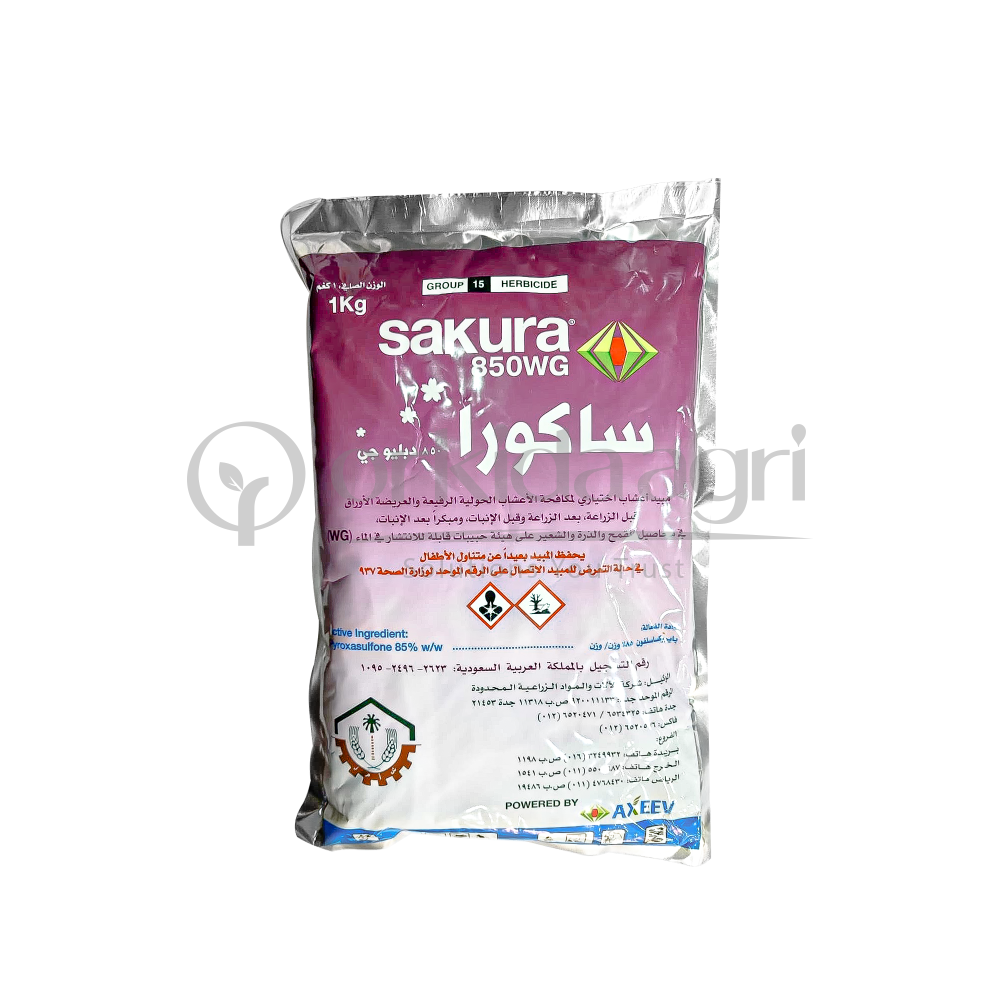
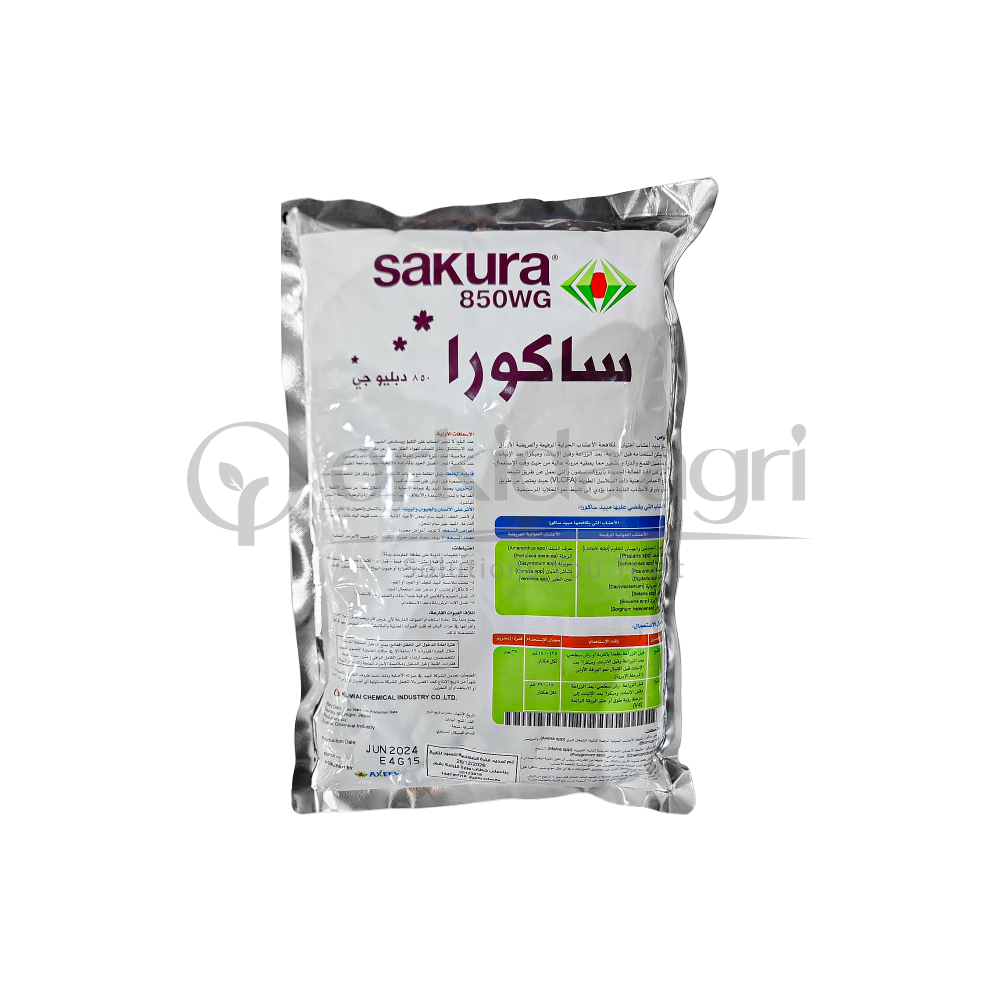

- Sakura 850 WG is a selective pre-emergence herbicide specifically developed to protect field crops from the most destructive weeds, narrow-leaved annual weeds, which are the primary cause of reduced wheat yields in the early stages of growth. The herbicide works in the soil immediately after planting, forming an effective protective layer that prevents weed seed germination and inhibits root and shoot growth in its early stages, thus ensuring a clean, competition-free environment for the crop during the critical growing season.
- Sakura is characterized by its good soil stability and high efficiency at low doses, making it a reliable choice in weed control programs, especially in wheat fields suffering from the spread of wild oats, wild ryegrass, and villars, which are weeds that are difficult to control after germination.
Product Features
- It helps to control weeds early, before they appear.
- Highly effective against narrow-leaved annual weeds.
- The crop gives a strong and clean start from the very beginning of the season.
- It reduces competition for water, fertilizer, and nutrients.
- It provides relatively extended protection for the soil after planting.
- It reduces the need for subsequent corrective sprays.
- Suitable for inclusion in integrated management and weed control programs.
The weeds it fights
- Annual slender grasses (primary specialization): wild oats – wild sorghum – annual grass – villars – millet – wild sorghum grass.
- Some broadleaf weeds that are sensitive in the early germination stage: purslane, cockscomb, wild mustard, and wolfberry.
Technical specifications
- Trade name: Sakura
- Product type: Selective herbicide
- Timing of use: Before germination
- Method of action: Through the soil
- Active ingredient: Pyroxasulfone 85%
- Formulation type: Water-dispersible granules (WG)
- Pesticide group: Group 15
- Net weight: 1 kg
- Country of origin: Japan
- Manufacturer: Kumiai Chemical Industry Co., Ltd
- Target crops: wheat (main crop), barley, and corn
How to use
- Sakura is applied as a soil spray immediately after planting and before weeds emerge. Adequate soil moisture is recommended to ensure activation of the active ingredient and formation of a protective layer. Do not apply to existing weeds, and avoid tilling the soil after spraying to maintain herbicide effectiveness.
- Wheat (the main crop) is used at a rate of 100-150 grams per acre, dissolved in 200-300 liters of water per acre.
- Spraying immediately after planting and before or after light irrigation prevents the germination of wild oats, wild ryegrass, and wild ryegrass from the beginning.
- Barley is used at a rate of 100-150 grams per acre, applied in the same way as wheat immediately after planting.
- Corn is used at a rate of 150-200 grams per acre.
- Spray immediately after planting and before weeds appear. Irrigation is recommended after spraying to activate the active ingredient.
Very important points for pesticide success
- Do not use on growing grass
- Do not turn over the soil surface after spraying
- Light soil moisture is preferred.
- Do not mix with other pesticides except after compatibility testing.
- Adhere to the recommended dosage according to soil type and weed density.
Additional benefits
- It helps improve the efficiency of nutrient absorption.
- It reduces the loss of fertilizer and water due to weed competition.
- It contributes to improving growth uniformity and crop vigor.
- It increases final productivity, especially in wheat.
- It is used within herbicide rotation programs to reduce the emergence of resistance.
Why is sakura important in wheat?
- Wheat is one of the crops most affected by narrow-leaved weeds, due to their close resemblance to the plant in its early stages, making post-emergence control difficult and costly. Using cherry blossom weeds before emergence helps prevent these weeds from appearing in the first place and reduces competitive pressure on water and nutrients, which directly impacts tillering vigor, uniform growth, and increases the number of spikes and final yield.
How the pesticide works
- Sakura works by being absorbed by the seeds and seedlings of grasses during the germination stage, where it inhibits cell division in the roots, prevents seedling elongation, and leads to germination failure or seedling death at a very early stage. It does not affect the crop when used at the recommended doses and timing.
Technical advice
- The true strength of Sakura lies in adhering to the correct timing, as it is a preventative pesticide before germination, and its best results are seen when used immediately after planting with adequate soil moisture.